teaching
Courses, teaching philosophy, and student supervision at Gdańsk University of Technology.
Teaching Statement
I teach with one goal in mind: to inspire self-exploration. I believe people learn most deeply when they are following their own questions – and my role is to create conditions where those questions emerge naturally, through practice and through work that carries real stakes.
My field, immersive audio, makes this approach almost unavoidable. Psychoacoustics, spatial perception, and Ambisonics are disciplines where abstract concepts remain abstract until a student actually experiences them – runs a measurement, analyses a room’s reflective behaviour, or hears a system respond in a way they did not predict. I deliberately delay full explanation until there is something to explain it against. Theory follows experience, not the other way around.
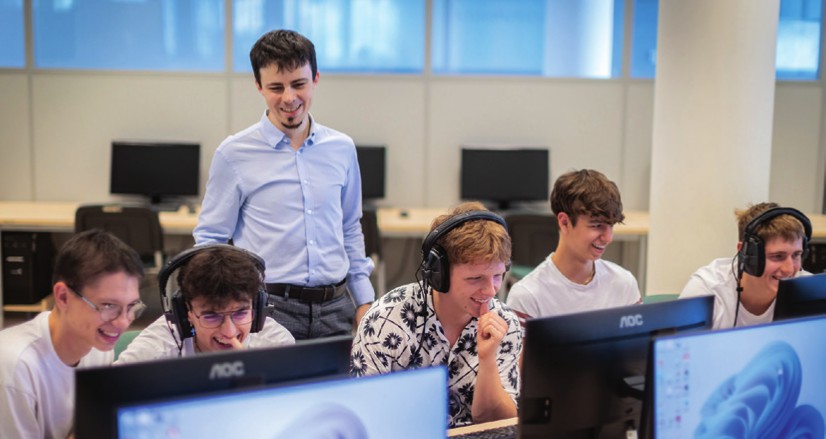
The clearest example of this is an Ambisonics acoustic measurement project I conducted with students at the Music Theatre in Gdynia. The topic was technical and experimental, and the students did not initially see why it mattered. Once they completed the measurements and began analysing the data, something shifted – they started describing the work as genuinely interesting on their own terms. By the end, they could independently interpret directivity patterns and reflection behaviour in a real acoustic environment. The fact that the Theatre’s technical crew found the results immediately useful amplified that further. The work was real, and they felt it.
Not everything I teach comes from my primary research area. I also teach a statistics course, and I approach it with the same practicality – partly because I remember being genuinely lost in statistics during my own studies. It felt like an obligation disconnected from anything I cared about. I now know it is one of the most transferable tools a researcher or engineer can have. Designed accordingly, the course aims to bring students to the point where they can read and critically evaluate research using statistical methods, and apply those methods independently in their own projects – diploma theses, research work, or beyond. Around the midpoint of the laboratory sessions, students regularly begin commenting unprompted on these connections. That moment of transfer is what I aim for.
Industry collaboration is a consistent part of how I teach, but I try to exercise judgement about what to bring in and what to leave out. Not everything from professional practice belongs in a course – some of it is too context-specific, some of it would short-circuit the learning process students need to go through themselves. The Theatre project worked precisely because the academic rigour came first; the real-world relevance emerged from that, rather than replacing it.
Where I am still working to improve is consistency between layers. My in-person teaching and my written materials – slides, laboratory instructions – are both intentional, but they are not yet equally polished. Some materials date from the early stages of my doctoral work. Closing that gap is my most concrete ongoing project: not a change of approach, but an alignment – making the written layer as purposeful as I try to make the classes themselves.
Courses
All courses are taught at the Faculty of Electronics, Telecommunications and Informatics, Gdańsk University of Technology.
| Course | Level | Type |
|---|---|---|
| Recording Technology I | B.Sc.Eng | Lecture + laboratory |
| Recording Technology II | M.Sc.Eng | Lecture + laboratory |
| Sound and Image Perception | M.Sc.Eng | Lecture + laboratory |
| Multimedia Technologies | B.Sc.Eng | Lecture + laboratory |
| Methods for Analysing Scientific Research Results | M.Sc.Eng | Lecture + laboratory |
| Sound in Games and VR | M.Sc.Eng | Lecture + laboratory |
| Student Team Research Projects | B.Sc.Eng / M.Sc.Eng | Project |
Recording Studio
I manage the KSMM Recording Studio at the Department of Multimedia Systems – an equipped facility for immersive audio production, psychoacoustic listening tests, and student project work. The studio supports Ambisonics, binaural, and object-based audio workflows and is used for both teaching and research.
Student Supervision
Current and recently completed diploma theses:
M.Sc.Eng (promoted)
| Year | Student | Title |
|---|---|---|
| 2025 | P. Perkowski | Study of the audiovisual correlation effect in a simulated 6DoF sound scene |
| 2025 | J. Czermiński | Generative deep neural network architectures for impulse response generation |
| 2024 | P. Kosior | Comparison of spatial sound recording techniques using Ambisonics and object-based audio |
B.Sc.Eng (promoted)
| Year | Student | Title |
|---|---|---|
| 2026 | P. Krzyżanowski | Close-miking instruments using an Ambisonic microphone |
| 2025 | F. Lewiński | Visualizer of an Ambisonic sound field |
Ongoing
| Degree | Student | Title |
|---|---|---|
| M.Sc.Eng | A. Sałata & R. Dobrański (joint) | Pilot implementation of a networked music performance system using Dante Audio-over-IP |
| M.Sc.Eng | F. Lewiński | Automatic synchronization of audio and video streams supported by timecodes and machine learning algorithms |
| M.Sc.Eng | E. Urbański | Simulation and adaptation of the Doppler effect in a 6DoF sound scene for modern hearing aids |
| M.Sc.Eng | M. Rębacz | Correlation of objective immersive sound quality measures with neurophysiological indicators measured by EEG |
| M.Sc.Eng | B. Repiński | Comprehensive spatial analysis of the acoustic field in the main hall of the Musical Theatre in Gdynia using Higher-Order Ambisonics |
| B.Sc.Eng | M. Bernat | Comparison of ambisonic recording techniques for digital and acoustic piano |
| B.Sc.Eng | P. Pawlukiewicz | Design, construction and automated measurement validation of a compact 1st-order ambisonic microphone |
| B.Sc.Eng | Z. Borowska | Implementation and performance optimization of an audio synthesizer VST plugin |
External Teaching
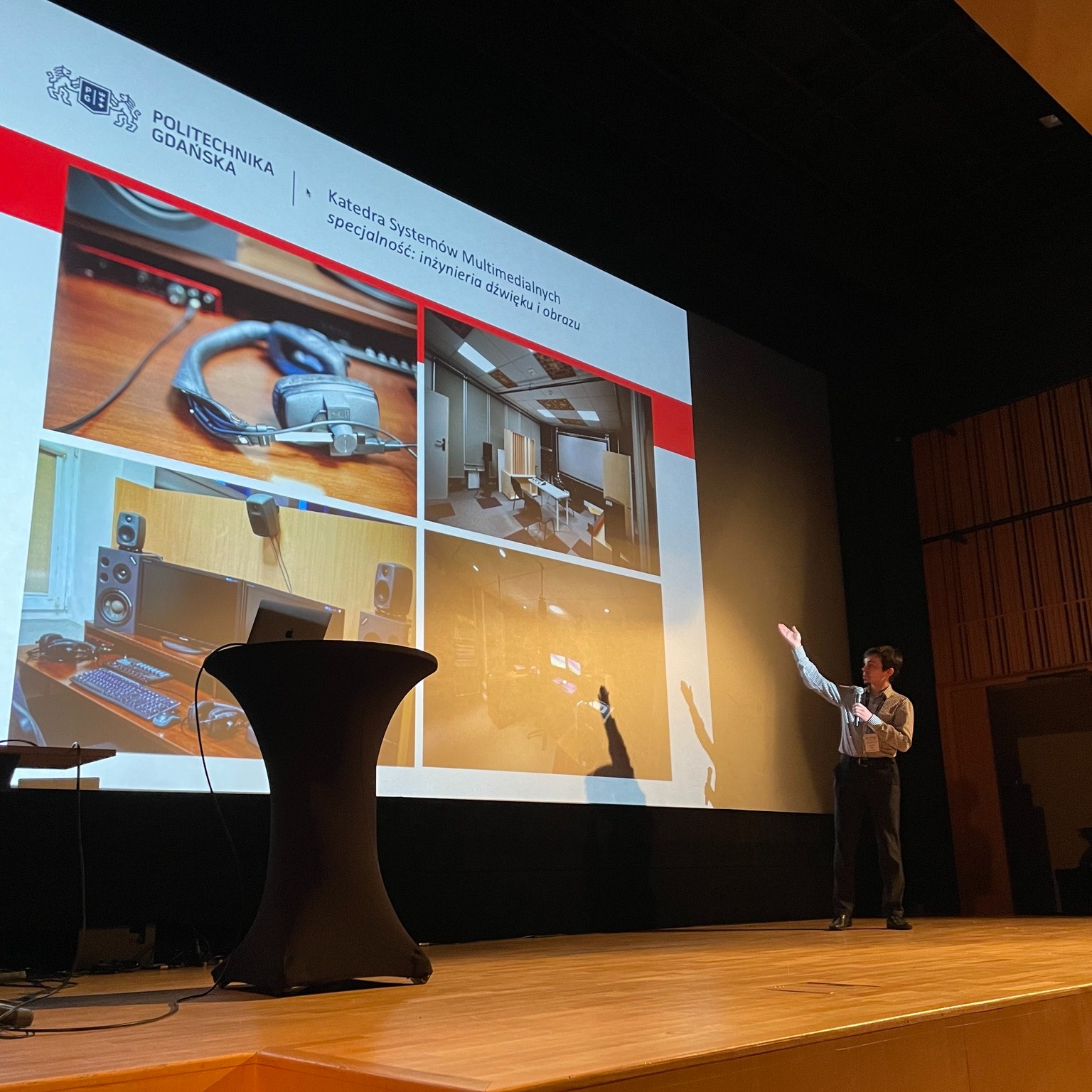
I am developing a specialist course in spatial audio recording and Higher-Order Ambisonics for the Branżowe Centrum Umiejętności (BCU) in Łódź, a KPO-funded national vocational excellence centre for audio recording and sound reinforcement (forthcoming).