AudioNet-Gda & AMuz Gdańsk Collaboration
A pilot Dante Audio-over-IP link between Gdańsk Tech and the Academy of Music in Gdańsk, open-source tools that measure its latency end to end (about 1.6 ms one way, half the measured round trip), and the wider partnership with the Academy.
AudioNet-Gda
AudioNet-Gda is a pilot networked music performance (NMP) system. It links the KSMM Recording Studio at Gdańsk University of Technology with a control room at the Academy of Music in Gdańsk (AMuz), about 4.3 km away in a straight line. CI TASK, which runs the Tricity Academic Computer Network, set up a 1 Gb/s Layer-2 link between the two campuses, so both rooms sit in one local network. Dante carries the audio uncompressed, and PTP keeps the Dante devices on one clock. The link worked on its first end-to-end test, on 13 July 2026. So far all tests have been technical: at AMuz a standalone Dante interface sends the test signals straight back, and no musicians have played over the link yet.
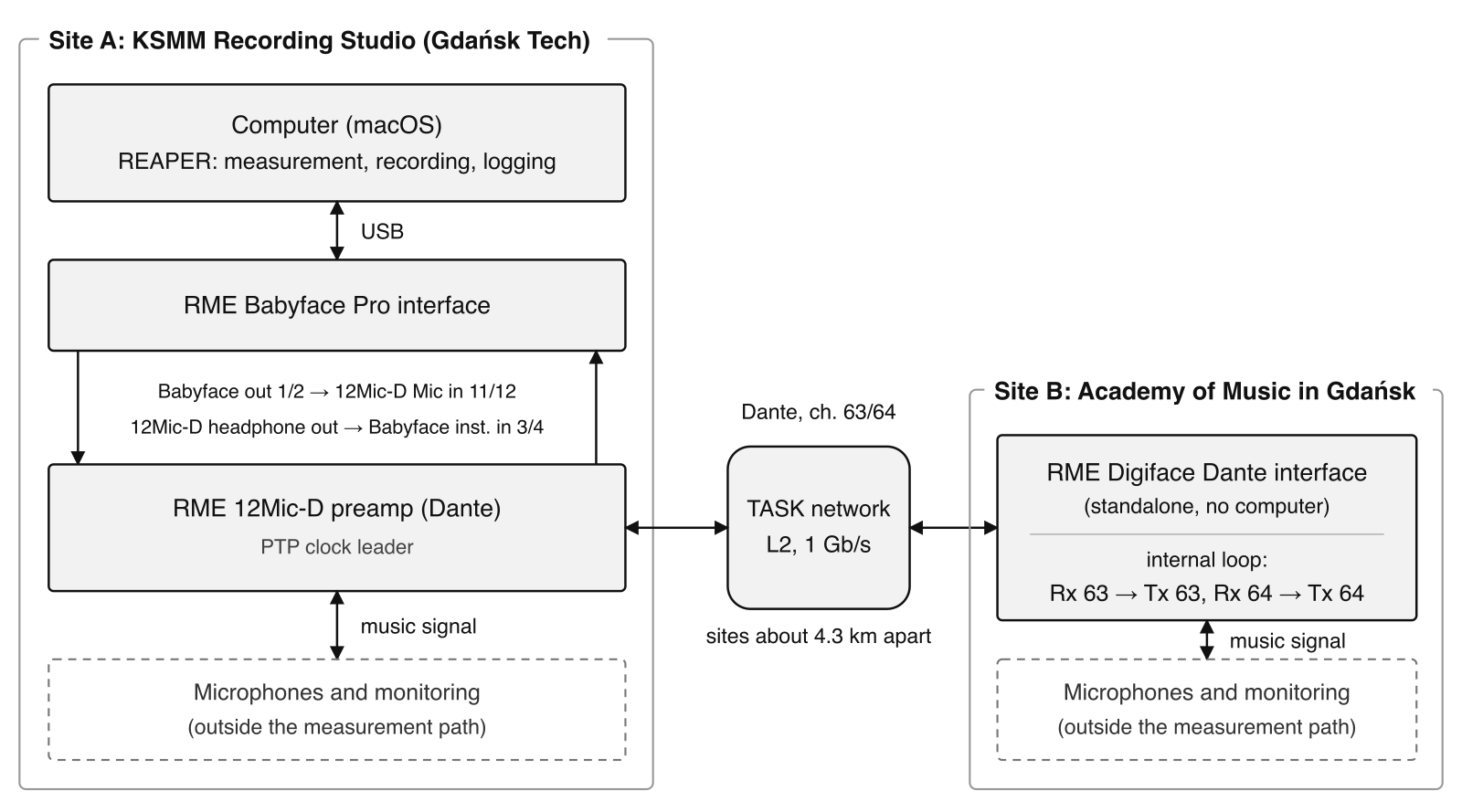
Measurement setup. REAPER plays the test signals from the Babyface Pro's analogue outputs into the 12Mic-D, which puts them on Dante. The Digiface Dante at AMuz sends them straight back, and the 12Mic-D's headphone output returns them to the Babyface. Microphones and monitoring sit outside the measurement path. Adapted from Fig. 2.1 of A. Sałata and R. Dobrański's thesis.
With Dante at its lowest latency setting (250 µs) and a 16-sample buffer on the measuring computer, a signal takes about 3.2 ms to go from Gdańsk Tech to AMuz and back, including two analogue-to-digital and two digital-to-analogue conversions. Most of that time goes to the conversions and the audio handling in the devices and the computer, not to the network. Half the round trip, about 1.6 ms, is the one-way latency if both directions take equally long, about a twelfth of the 20 ms often cited as the tolerance threshold for synchronous ensemble playing. In the thesis stability sessions on 21 September 2026, 49 minutes at 250 µs and 91 minutes at 500 µs, the timecode reading did not change and no timecode frames were lost.
Dante Controller reports latency only at the network level, so the project needed its own tools for the whole audio path. Two REAPER plugins measure the round trip continuously to the nearest sample: one correlates a maximum-length sequence (MLS), the other sends a custom timecode modelled on SMPTE LTC. A third plugin injects known delays for testing, and Lua scripts log the readings and automate the linearity test. The plugins tracked injected delays exactly, and in a check at the 500 µs setting Room EQ Wizard agreed with them to within 13 µs, less than one sample. The tools are open source (MIT licence), on GitLab and GitHub, with releases archived on Zenodo. I developed the plugins and scripts; A. Sałata and R. Dobrański added the timecode’s adaptive frame-rate mode, prepared the measurement setup, and carried out, validated and analysed all the measurements for their joint M.Sc.Eng thesis (2026), under my supervision.
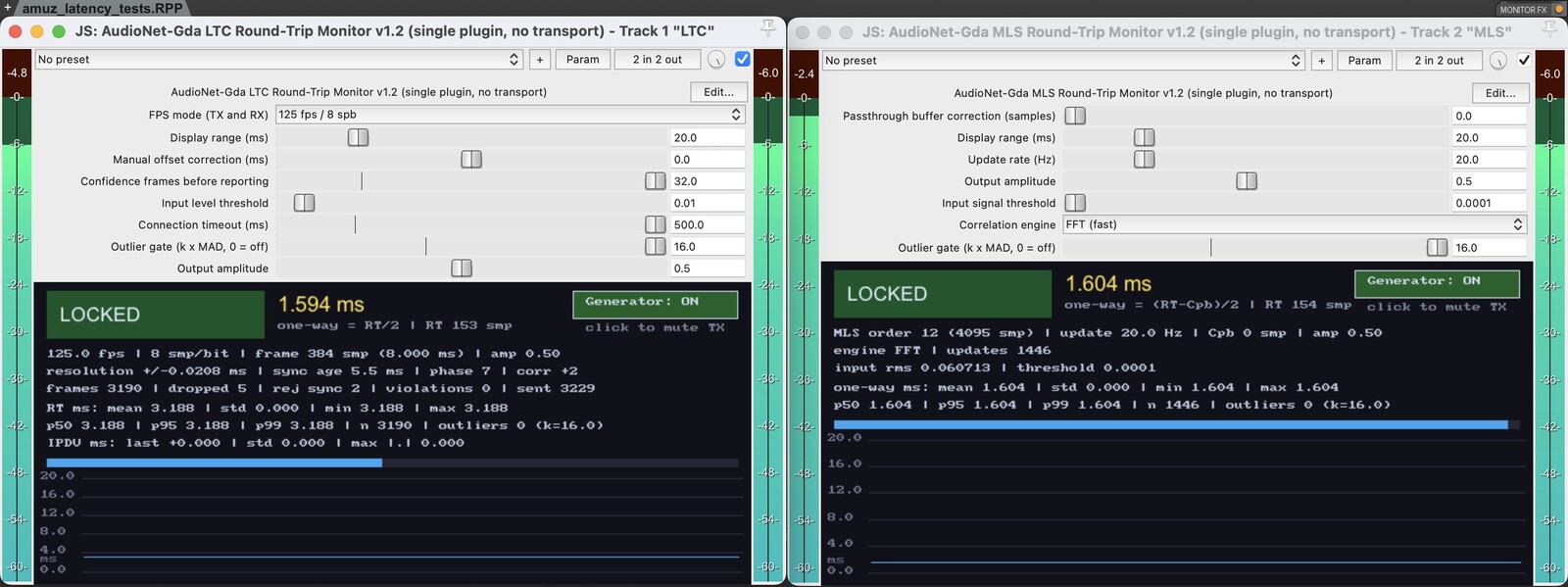
Both round-trip monitors on the live link, 28 October 2026. The timecode monitor (left) reads a 153-sample round trip, 1.594 ms one way; the MLS monitor (right) reads 154 samples, 1.604 ms. Neither reading changed during the run.
A student project team now has the task of running the first real recording sessions over the link, and a procedure for them is already prepared. We are also buying NDI converters to add a video link, since Dante’s own video hardware is too expensive. Port mirroring on the link lets a capture host record the Dante packets themselves, so network timing can be compared with the plugins’ readings. Multi-day stability logging is also planned.
Partnership with the Academy of Music
On 19 March 2025 the rectors of Gdańsk University of Technology and the Academy of Music in Gdańsk (Akademia Muzyczna im. Stanisława Moniuszki) signed a letter of intent on cooperation in education, student projects, joint elective courses, and artistic and scientific work, including audio recordings. Coverage: Gdańsk Tech news, AMuz news.
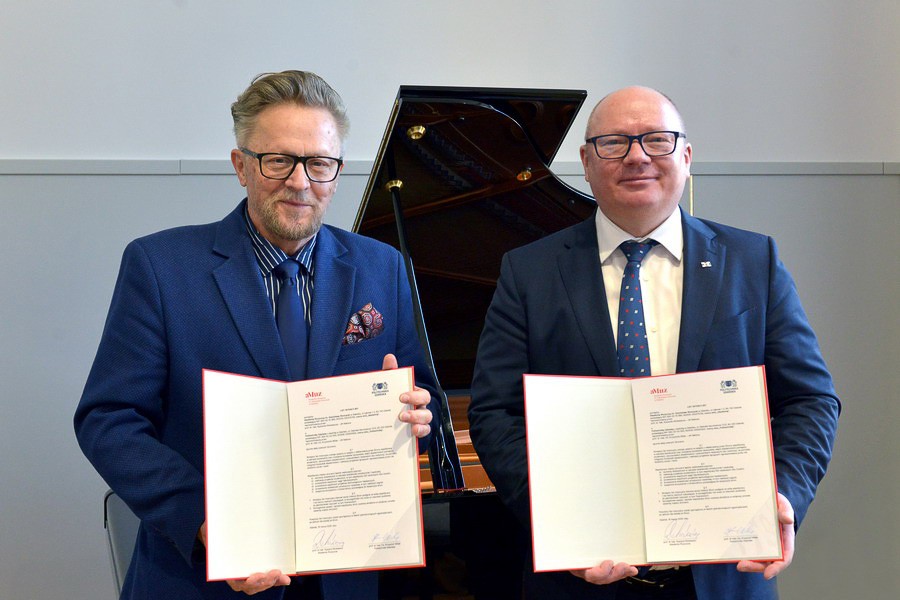
Prof. Ryszard Minkiewicz, Rector of the Academy of Music in Gdańsk, and Prof. Krzysztof Wilde, Rector of Gdańsk Tech, with the signed letter of intent, 19 March 2025. Photo: Krzysztof Krzempek/Gdańsk Tech.
In August 2026 the Academy of Music and the Academy of Fine Arts joined Gdańsk University of Technology, the University of Gdańsk and the Medical University of Gdańsk in the Fahrenheit Universities consortium. The enlarged consortium was celebrated at the annual academic-year opening parade, “Niech żyje nauka!” (“Let science live!”), on 10 October 2026.
From the 2026/2027 academic year I teach two courses in AMuz’s new Music Production specialization: Editing and Post-production of Recordings (laboratory) and Analysis of Recordings and Music Production (lecture, biweekly).
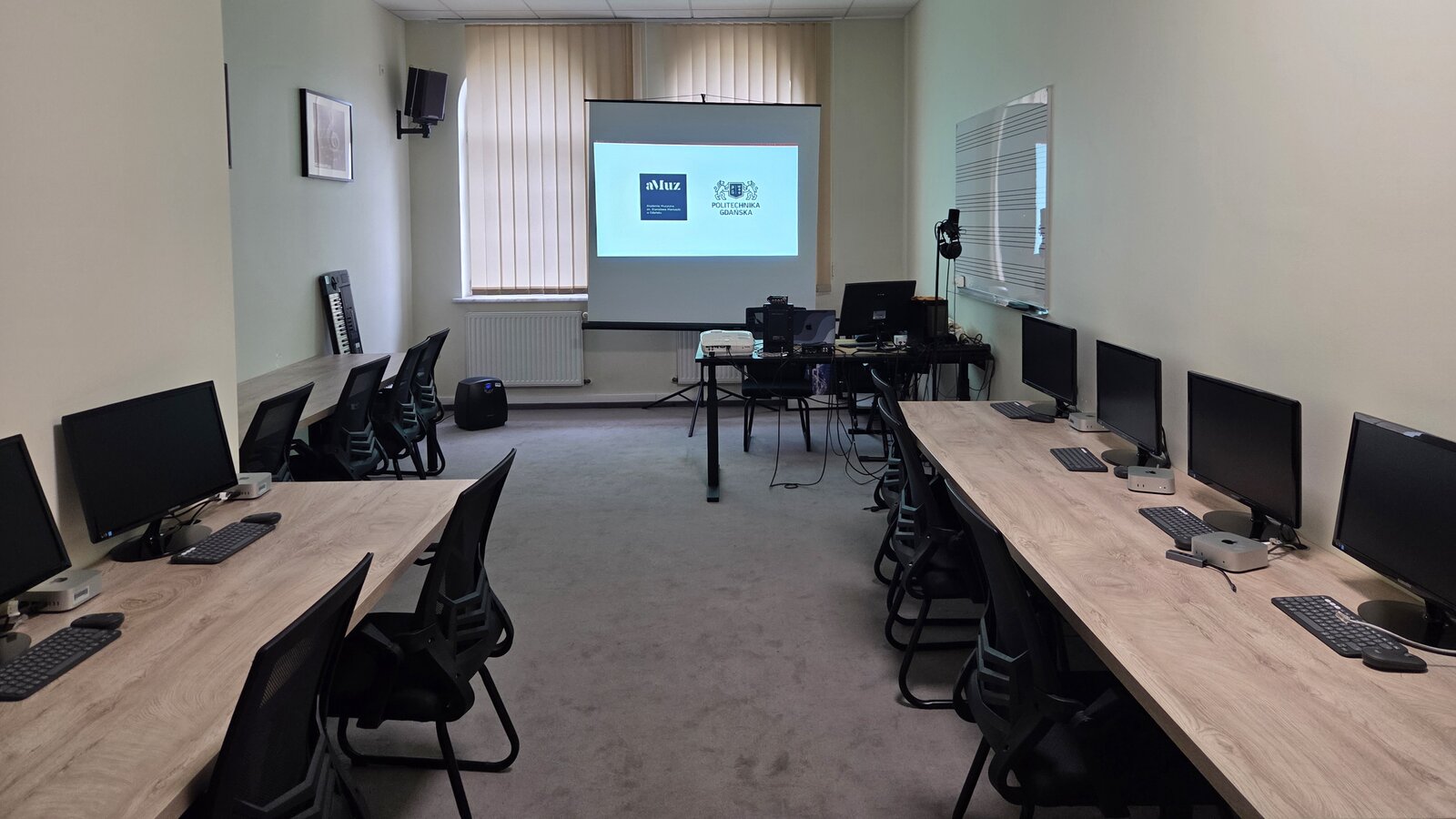
My AMuz classroom on the first day of classes, 6 October 2026.
Recordings
Students regularly record ensemble and choir performances at AMuz. The recordings feed studies of spatial audio recording methods, and the sessions double as field training for the Recording Technology courses. My own sessions with AMuz performers, among them Mikołaj Sikała, Piotr Pawlak, Jan Staruch and Bartosz Wiśniewski, form a subset of the HOA Recording Corpus.
Two joint sessions so far, both with KSMM students recording AMuz musicians:
- March 2025, at AMuz: O. Górecki, B. Bonarowski and R. Kulesza recorded vocalist I. Zielińska and guitarist M. Rajca performing together.
- March 2026, at the KSMM Recording Studio, the first joint session on the Gdańsk Tech side: J. Tarczewski, M. Bernat and P. Szydłowski recorded a trumpet-and-piano performance. Their recording, Alien, won 3rd prize in the acoustic recording category of the recording competition at NTAV 2026 (department news).
Acknowledgement
I thank CI TASK for setting up the link between the two campuses (CI TASK service no. E1841/2025); the measurements over the link would not have been possible without it. Thanks also to the AMuz staff for making their infrastructure available.