1st-Order Ambisonics Microphone Build
Design, construction, and acoustic characterisation of a custom 1OA tetrahedral microphone.
A student group project to design and build a complete first-order Ambisonics tetrahedral microphone from scratch — covering capsule selection, electronics design, 3D-printed housing, RF shielding, and acoustic characterisation in an anechoic chamber.
Electronics. The team worked through two preamplifier iterations. The first prototype used TL082 op-amps with TSB-2555 capsules, revealing signal path issues. The second iteration adopted the OPA Alice circuit (OPA1642), which offered better noise performance; an initial unshielded version suffered noise and burned amplifiers. The final configuration uses four TSB-2555BXZ3-GP capsules with OPA Alice preamp boards — a design adapted from the open-source Ambi-Alice microphone.
Housing. Multiple enclosure variants were designed in Autodesk Fusion 360 and 3D-printed, iterating towards a compact tetrahedral geometry that correctly positions all four capsules. The final housing is wrapped in copper tape for RF shielding.
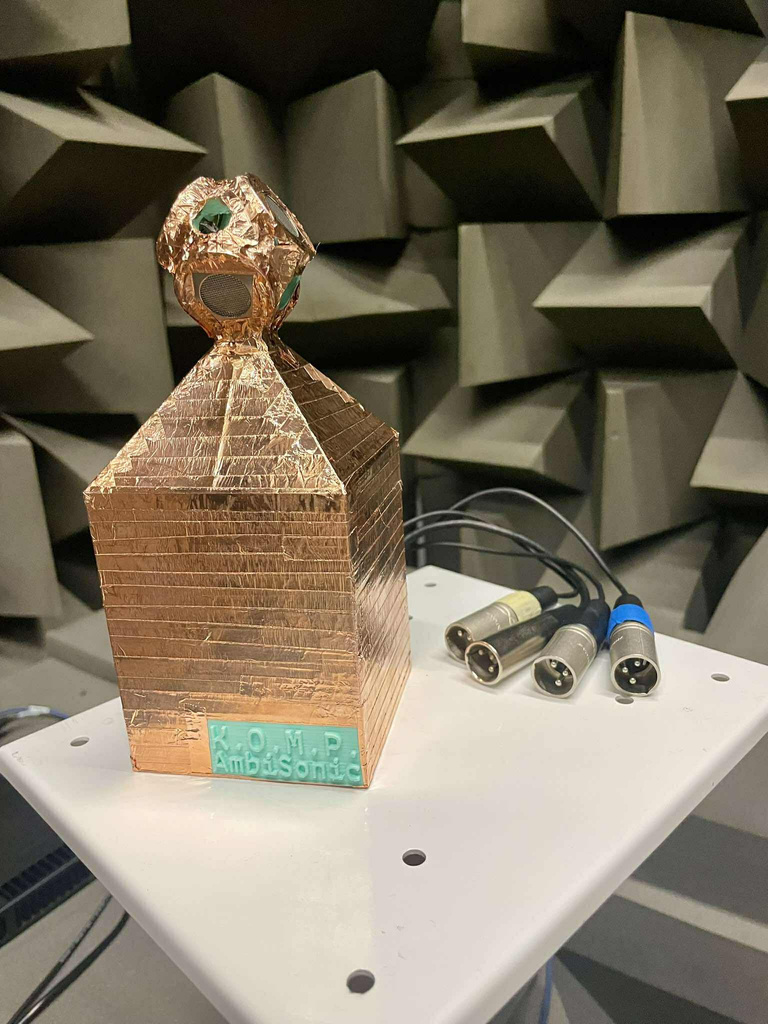
Final microphone: TSB-2555 capsules, OPA Alice preamps, custom 3D-printed housing with copper tape shielding.
Acoustic characterisation. Capsule frequency responses were measured in the anechoic chamber at the Department of Multimedia Systems using REW, with a Genelec reference monitor as the stimulus source. The four capsules show close matching across the midband (300 Hz–2 kHz), with approximately 5 dB spread in the resonance region near 200 Hz — typical for unmatched capsule pairs of this type.
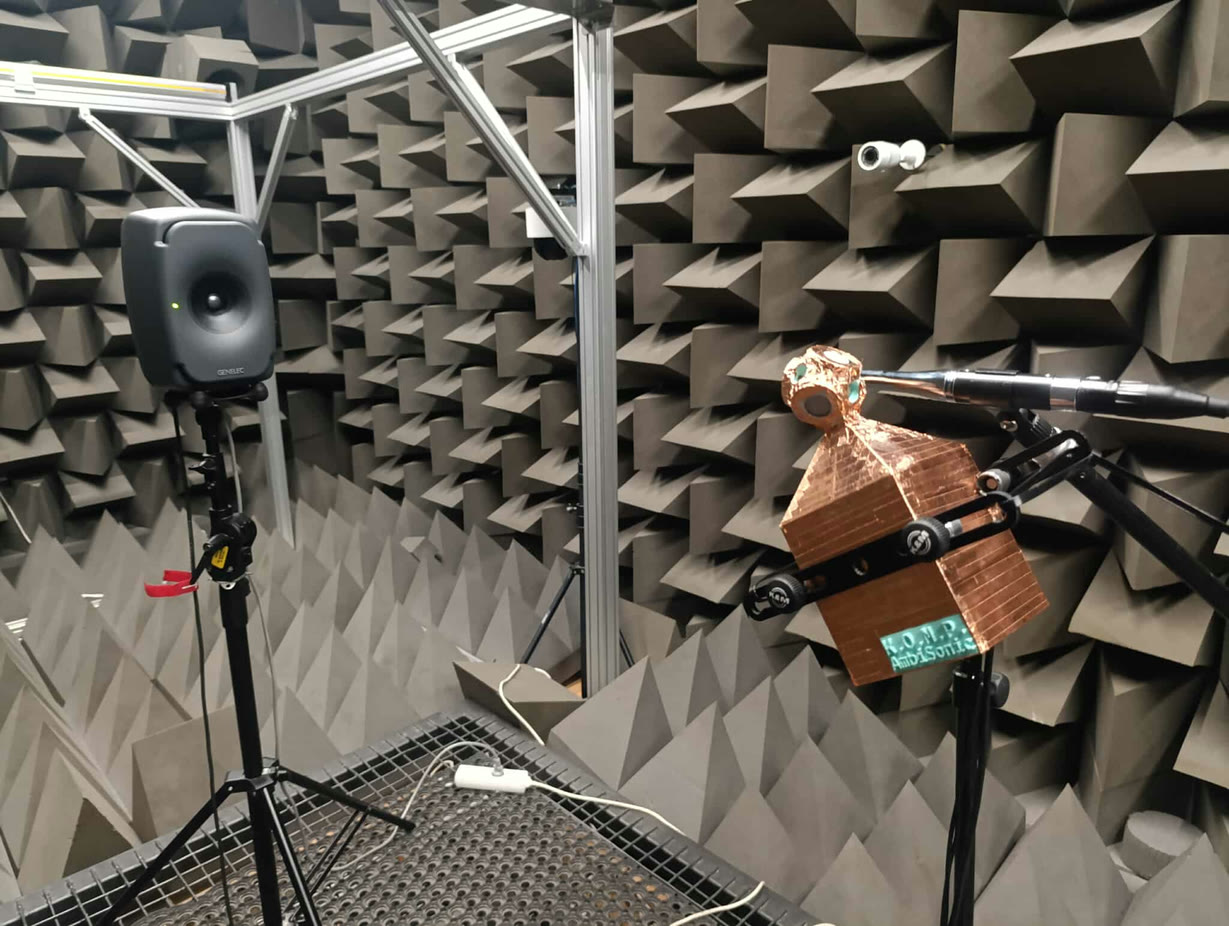
Capsule characterisation setup: microphone on a stand in the anechoic chamber with a Genelec reference loudspeaker, analysed with REW.
A-to-B format conversion is performed in Reaper with dedicated plug-ins. Presented at the AES Europe 2025 conference (Warsaw, 22–24 May 2025) with a poster titled DIY Construction of a First-Order Ambisonics Microphone.
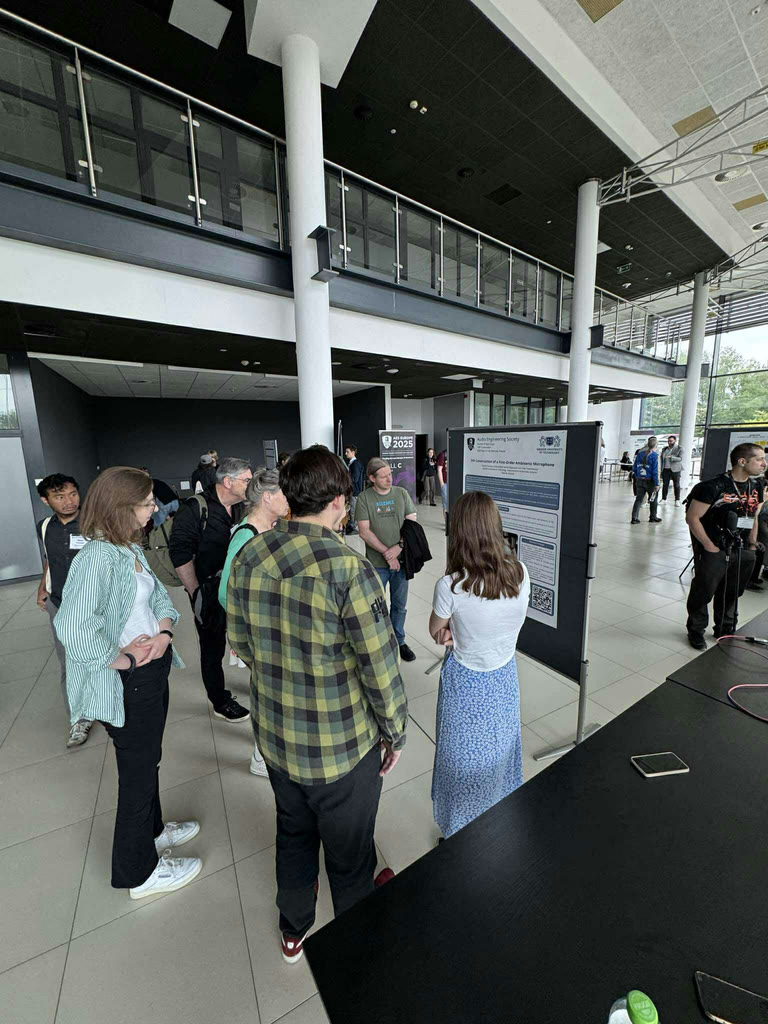
Poster presentation at the AES Europe 2025 Student Project Expo, Warsaw.
Student project led by K. Szwaba, with O. Wójcik, M. Nijakowski, and P. Pawlukiewicz (KSMM 2024/2025). The work is continued as a B.Sc.Eng thesis by P. Pawlukiewicz.